The research

What we are trying to find out about your dog.

Dogs get about a decade. Published research on millions of dogs tells us what tends to be true across a whole population. Whether any of it says something useful about the one asleep on your floor is an open question, and nobody has tested it. That is the question this company exists to answer, and it starts with the walk you were going to take anyway.
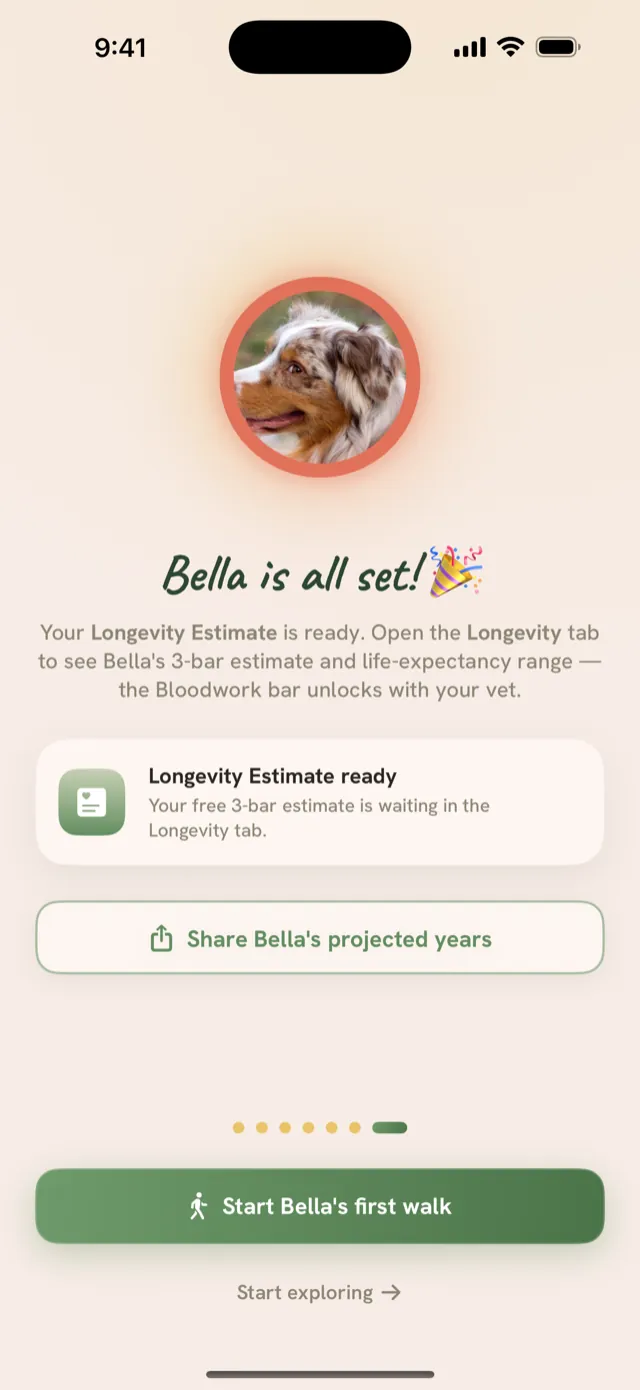
Tailmates onboarding screen: a photo of Bella the Australian Shepherd above the words Bella is all set
The open question

Big studies tell us about dogs. We want to know about your dog.

Large veterinary studies have found that size tracks with how fast dogs age, that a lean body condition goes with a longer life, and that frailty goes with higher mortality. Those are findings about populations, and they belong to the researchers who made them.

Nobody has checked whether stacking them into one transparent number tells you anything useful about an individual dog. We wrote that number down in the open, and we are building the group of dogs that could one day test it.

Those findings are theirs, not ours: Kraus 2013 on size and aging rate, Kealy 2002 on lean body condition, Salt 2019 on body weight and mortality, Banzato 2019 and Russell 2024 on frailty.

Where you come in

Your walk is the part the records never had.

The life tables underneath your dog’s score come from veterinary records. Millions of dogs’ worth. Records capture the visits. They do not capture the ordinary Tuesday, and the ordinary Tuesday is most of a dog’s life.

A logged walk captures one, and you were taking it anyway. One honest limit, said out loud: a logged walk measures walking you were on, with a phone in your pocket. It is not everything your dog did that day.

So the walk part of the score is deliberately modest. Logged walks can only ever raise it, never lower it, by at most half a year. A dog with nothing logged is treated as neutral, not penalized.

Published life tables: Montoya et al. 2023 (13.3 million dogs) and Teng and O’Neill 2022.
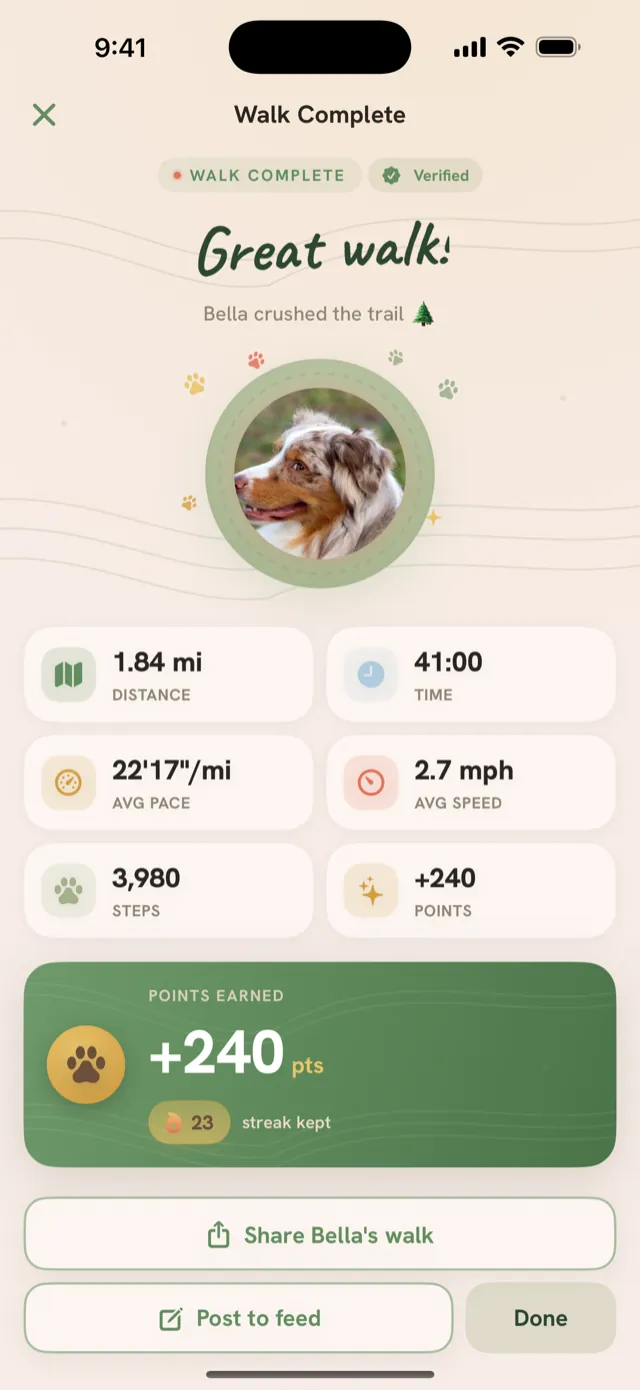
Tailmates walk-complete screen: 1.84 miles and 41 minutes logged, +240 points earned and a 23-day streak kept
Where your vet comes in

Your vet’s bloodwork is what makes it sharp.

An estimate built from breed, body condition, and walks is a rough read. A real blood panel makes it a specific one. Up to 31 results come off your vet’s lab report, and two ratios are calculated from them rather than guessed.

Your veterinarian reviews the panel and reads it against the report in front of them, inside a real relationship with your dog as their patient. The lab validates the data. That is what lab verified means: it describes the inputs, and the number stays ours to compute. The care stays with your vet.

A lab verified read stays current for a year, then flags as stale so you know when it is time for fresh bloodwork.
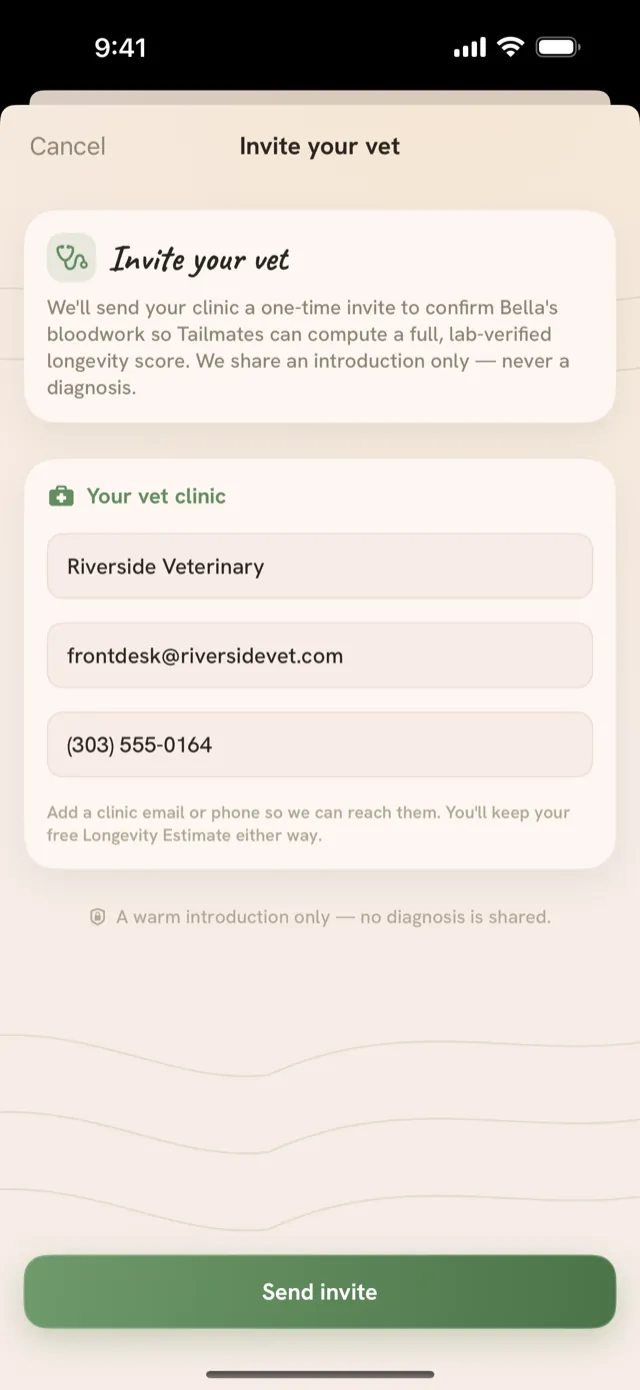
Tailmates invite-your-vet screen: a one-time invite to Riverside Veterinary with the clinic email and phone, sharing an introduction only and never a diagnosis
How the number is made

Every number here is one you can check.

A glass box is worth more than a clever box, so we built the boring one on purpose.

  • No score is produced by an AI model. A model reads your vet's lab PDF and suggests a body condition from a photo, and the photo suggestion is allowed to say it does not know. Every scored number comes from arithmetic that is written down.
  • Every score records which version of the model produced it and a fingerprint of the exact coefficients in use. Replaying one of those numbers end to end, independently, is a gate we have written down as still open.
  • When essential information is missing, the score refuses to show a headline instead of guessing at one.
  • The result is always shown as a range, never a date, and the range widens when we know less about your dog.
How to read the number

What it is, precisely.

Six things worth knowing about a number like this, so you read it for exactly what it is today and where it is headed.

  • A transparent estimate today, a tested prediction next

    The road

    The score reads what published research supports. Following dogs to an outcome, and checking the number against how long they actually lived, is the work ahead.

  • An everyday wellness read

    By design

    Educational and non-diagnostic. Your vet leads the medicine and knows your dog; the score is here for the ordinary days in between.

  • A range, always

    By design

    You see a band, because a band is honest and a single date would be a guess wearing a suit.

  • A spot on your dog's own curve

    By design

    The position you see is where the model places your dog on a modelled curve. It stands on its own, independent of any other dog.

  • An estimate in friendlier units

    By design

    The younger-or-older number is the same estimate, expressed in years. It is a modelled read, distinct from an epigenetic clock or a direct measurement of biology.

  • Tailmates' math, your vet's care

    By design

    The score is ours to compute. Your vet reviews the panel, reads it, and stays in the loop on your dog.

What we intend to publish

In this order, because the data allows no other

Publishing the method first, and saying plainly that the test does not exist yet, is what will make the test believable when it comes. A methods paper that oversells itself is worth less than no paper.

  1. 01Ready to write now

    The method

    How the score is computed, what each input contributes, what the range means, and where the model refuses to answer at all. Reproducible from published code. This is the first paper and it makes no claim about survival.

  2. 02Once dogs are contributing

    Who is in the data

    A plain description of the dogs whose data we hold, and an honest account of how they are not a representative sample of all dogs.

  3. 03Once repeat measurements exist

    Does it measure consistently

    Does the same dog get the same read twice. Does a photo-graded body condition agree with a veterinarian grading the same dog blind. Does the model abstain when it should.

  4. 04Years away

    Does it predict anything

    The real test, and the one that needs outcomes we are still building toward. When it is done, we publish the full claim, and never a smaller, softer version of it.

  5. 05After the step above

    Does acting on it change anything

    Whether a dog whose owner responds to the score ends up better off. That question calls for a designed study, and that study is the horizon this whole program points at.

Where we actually are

The unflattering version

Most companies publish this list after it looks good. Here it is while it still looks like this.

  • Dogs contributing data to research

    Coming

    The sharing controls are on the way to the app. Until they ship and you switch one on, your dog's data stays with you, out of any study.

  • Outcomes observed

    The work ahead

    Following dogs to an outcome is the data a survival claim needs, and building toward it is exactly what this program is for.

  • A model fitted to real outcomes

    Not yet. That's the work

    Today's score is built from published research, not from Tailmates data. Every weight is a literature prior, hand-set and written down.

  • The methods paper

    Written, submission next

    A manuscript exists in the repository alongside the algorithm it describes. Peer review and submission are the next step.

  • Independent review

    Seats open

    A veterinary lead, an outside statistical reviewer, a preregistration on file. Those seats are open and filling them matters.

Until the fourth step above is done, the honest description of Tailmates is this: we compute a transparent estimate, and we are building the group of dogs that will one day test it.

Our failure conditions

What would make us stop

A program with no failure condition is not research, it is marketing with a bibliography. So we wrote ours down first, while we still had nothing to protect.

If any of these turns out to be true, you will hear it from us, on the same schedule as good news, in the same amount of detail.

  • The score turns out to predict nothing. If it does no better than age, breed size, and sex on their own, we publish that and stop calling it a longevity score.
  • It is systematically wrong for a group of dogs we serve. Those dogs get no number rather than a wrong one.
  • The dogs in the data are too unusual to learn from. If contributing correlates with being healthy, we publish that and stop making claims about dogs in general.
  • Sharing stops being genuinely voluntary. If opt-in rates only move when we push, we remove the mechanism instead of tuning it.
  • Anything we look at shows harm. Immediate stop, immediate disclosure, no waiting for a publication window.

How we will report, every time

  • We state what we are testing before we test it, or we label the result exploratory.
  • Null results and negative results publish on the same schedule as good ones.
  • We report how well the numbers are calibrated, not only how well they rank dogs.
  • The selection bias goes in the summary, not the appendix.
  • Code and specification ship with each paper. The model is the claim.
  • We never turn a hazard ratio into a number of years for you without saying what that conversion assumed.

The ask is simple.

This part is a gift, freely given. Sharing controls are coming to the app; when they ship, every switch starts off, turning one on earns you no points and no badge, and the app works the same either way.

Walk your dog. That is the whole ask.

Read the mission this belongs to.

The score you see today is educational and built for everyday wellness. Your veterinarian leads the medicine and knows your dog; the score is here for the ordinary days in between.